
Larger XCarb® angles, wider applications
Expanding the availability of low carbon-emissions steel solutions requires more than innovation alone: it takes close collaboration across departments, from steelmaking and rolling to quality and research and development (R&D). Thanks to a shared commitment and years of development work, ArcelorMittal Long Products Luxembourg in Rodange has successfully extended its XCarb® recycled and renewably produced angle range up to L250 in grade S460, opening the door to even larger dimensions in the future.
For the past few years, equal legs angles (known as "L" sections because of their shape) have been available in XCarb® recycled and renewably produced steel in sizes up to L150 (meaning with legs measuring 150 mm), giving them one of the lowest CO2e footprints available on the market: 333 kg of CO2e per tonne of finished product.
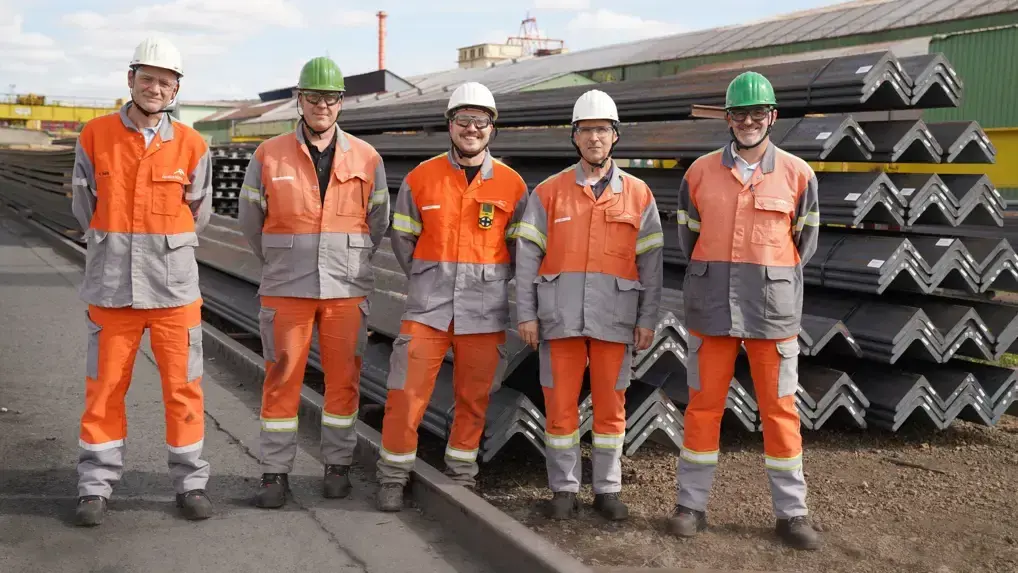
From left: Yacine Badi, industrial engineer, global R&D, Emmanuel Rossi, head of Mill A production Rodange, Christophe Pauly, product development engineer, quality department, Fabrice Gattone, quality engineer Rodange, Christophe Seivert, head of Mill A finishing Rodange
XCarb® recycled and renewably produced angles are now available in the full L250 range. The newcomer, the L250 in grade S460, has just been rolled and tested at Mill A in Rodange, using the new bloom format cast in the neighbouring mill of Belval. This development is part of the SteelUp! project, which aims to modernise the entire ArcelorMittal Long Products Luxembourg steelworks in Belval, through a new, more efficient Electric Arc Furnace, allowing CO2 emissions to be reduced even further.
XCarb® recycled and renewably produced to reduce the CO2e footprint of projects
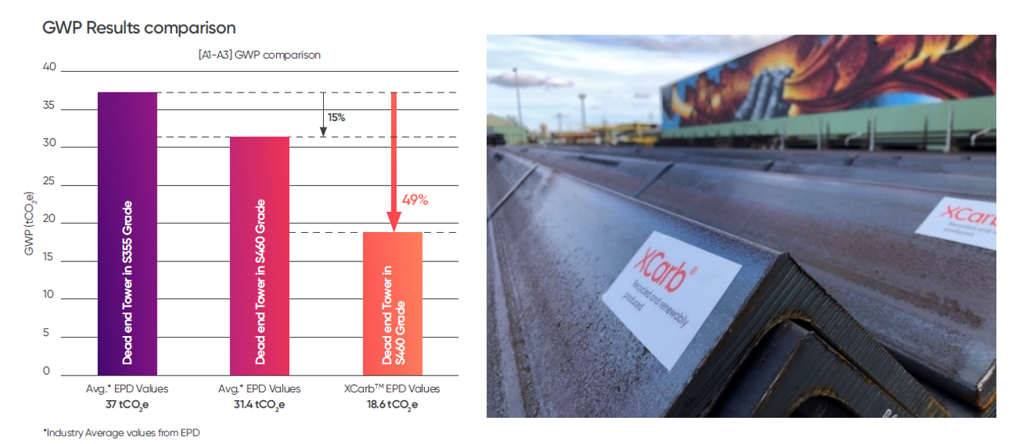
Combining the use of S460 high strength steels and XCarb® recycled and renewably produced steel allows considerable carbon-emissions savings, up to 49% reduction compared to industry average value, as shown in the chart below for a lattice tower use case.
Bigger angles, wider applications – lattice towers in focus
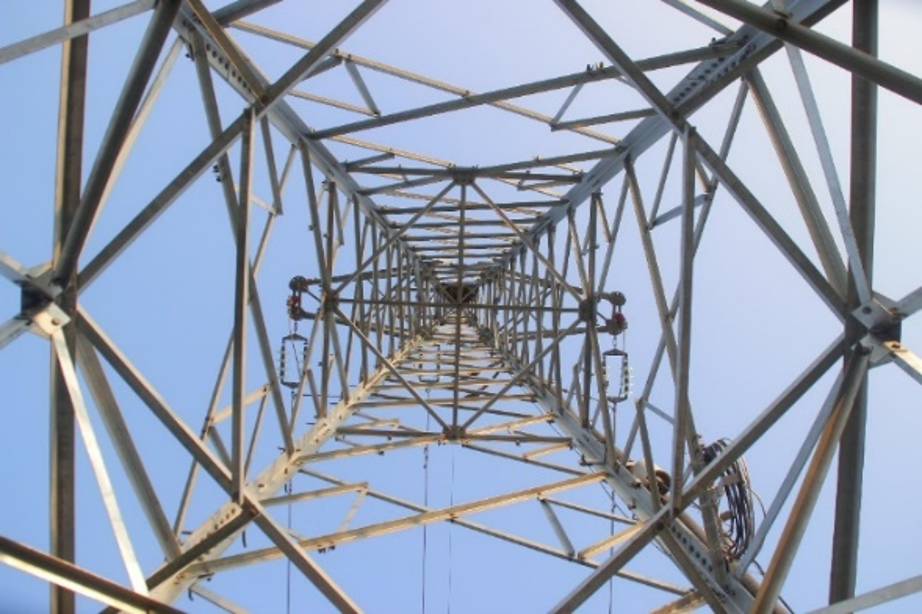
Making L250 angles available in the high-strength S460 grade, in XCarb® recycled and renewably produced, also enables innovation within their main applications, with lattice towers being a prime example.
Over the next decade, electricity transmission capacities are expected to double, driving a significant increase in conductor sizes and the loads imposed on high-voltage transmission towers. As a result, modern steel lattice towers are likely to be substantially heavier than their predecessors, as they are designed to withstand greater mechanical loads and meet more stringent requirements.
Unprecedented demands are being placed on both new and existing infrastructure. Many transmission towers in service were constructed using S355 structural steel and are now approaching their intended load capacities, raising concerns about their long-term structural performance and reliability.
© Xiao Feng Yao from Pixabay
S460 high-strength steel provides an efficient and sustainable solution. By upgrading from S355 to S460, transmission towers can achieve a 20% to 30% increase in structural capacity while retaining the same, proven designs without requiring any complex fabrication processes. This enables utilities and network operators to accommodate higher transmission requirements without fundamentally redesigning established tower configurations.


