
Sustainability

Smarter steels for people and planet
Steel has always been a cornerstone of human progress, and it will remain indispensable thanks to its strength, durability, flexibility, and reusability. As the most easily recycled material, steel is perfectly suited for a circular economy. However, the next chapter of our story must safeguard the needs of future generations. That means steel must evolve, becoming smarter, cleaner, and more sustainable.
Our strategy for sustainable development
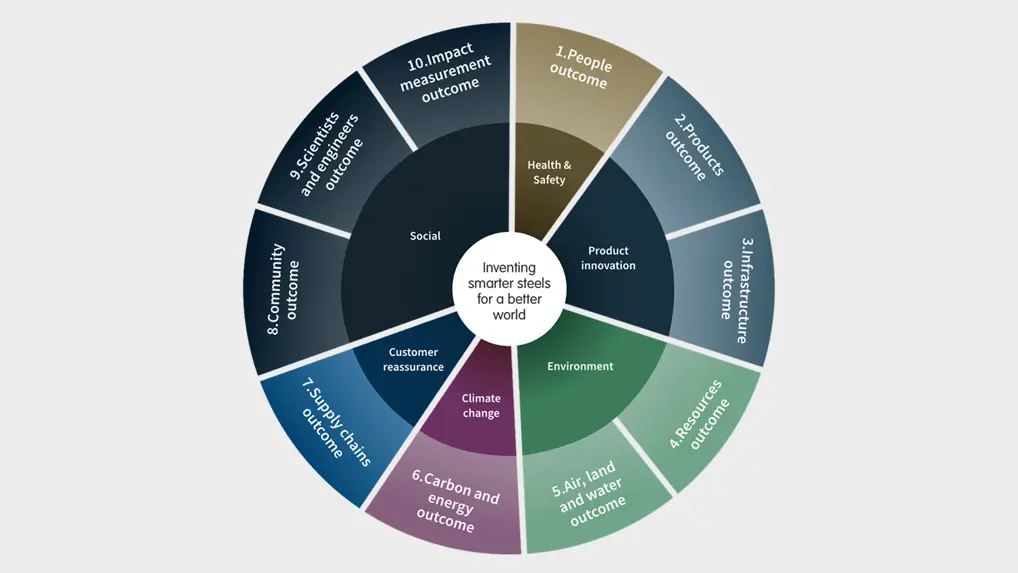
Our business is committed to building solutions for the sustainable development of the world. We frame this in our 10 Sustainable Development outcomes, which act as a compass to describe the business we know we must become.
To structure our approach to achieving them, we focus on six themes: product innovation, safety, social, environment, climate change, customer reassurance.
Decarbonisation is at the heart of achieving them, driving the transformation of steelmaking towards net zero.
XCarb® recycled and renewably produced
One of the first decarbonisation initiatives from ArcelorMittal Europe – Long Products is XCarb® recycled and renewably produced. To produce XCarb® recycled and renewably produced, ArcelorMittal Europe – Long Products uses at least 75% of steel scrap1 in the EAF.
All of the electricity needed to transform the scrap into XCarb® recycled and renewably produced steels comes from renewable sources from solar and wind power. The energy is provided by suppliers who are connected to the same grid as our production sites and whose projects are recent.

The combination of recycled content and renewable energy allows ArcelorMittal Europe – Long Products to offer steels with very low levels of CO2 emissions per tonne of finished steel. XCarb® recycled and renewably produced steel can have a CO2 footprint as low as 300kg per tonne of finished steel when the metallics are 100% scrap.
This is significantly lower than the average for the global steel industry which is around 2.3 tonnes of CO2 emissions per tonne of steel products2.


1 For specific products: minimum scrap content of 50%. Please contact us for more information.
2 Material Economics, 2018 The circular Economy: A powerful force for climate migration.
Frequently asked questions
Discover XCarb® recycled and renewably produced steel
ArcelorMittal’s breakthrough in low-carbon steelmaking. Using up to 100% scrap and 100% renewable electricity, these products help you cut CO2 emissions dramatically while meeting top sustainability standards. Build smarter and future-ready.

Transforming the way we make steel
We’re redefining steelmaking with innovation and sustainability at the core. Across our sites, we’re adopting cleaner energy, smarter processes, and pioneering technologies like XCarb® to reduce carbon emissions. This is the future of steel—made responsibly, efficiently, and with purpose.


ArcelorMittal is one of the suppliers whose end product has significantly reduced CO2 emissions through the use of recycled scrap and renewable electricity. This means that the U5 can also serve as a model for other public construction projects.”
Case studies
Explore real-world examples of how our low-carbon steel solutions are helping customers reduce their environmental impact while maintaining performance and quality.
Bologna airport parking
Over 2,500 tonnes of XCarb® recycled and renewably produced steel beams and columns manufactured in our mills of Belval and Differdange (Luxembourg) have been supplied for the construction of a new car park in Bologna, Italy. This marks the first parking structure in Italy to use exclusively XCarb® recycled and renewably produced steel sections.

Saint-Gervais Mont Blanc
With an impressive network of 445 km of ski slopes and 110 ski lifts, Saint-Gervais is the main gateway to the Evasion Mont Blanc ski area, renowned for its efforts to develop sustainable tourism. The choice of ArcelorMittal’s XCarb® recycled and renewably produced steel for the rope of the Alpin gondola lift is a perfect example of [...]

ResponsibleSteel™
While reducing emissions is a key goal for ArcelorMittal and our customers, we are also considering sustainability in a broader context. As part of that approach, ArcelorMittal has played a pivotal role in establishing the ResponsibleSteel™ standard since 2015.
ResponsibleSteel™ is the steel industry’s first global multi stakeholder standard and certification initiative. Now established as a non-profit organisation, ResponsibleSteel™ develops sustainability performance standards and has established an independent thirdparty certification programme for the steel value chain. This ground breaking initiative now involves over 40 members and associates, made up of companies and civil society organisations from around the world.


Independent audits verify performance
The standard is based on 12 Principles which, in turn, include a variety of criteria and requirements. To achieve ResponsibleSteel™ certification, each site must undergo a rigorous third-party audit, with the resulting report reviewed by an independent Certification Committee which makes the final certification decision.
The audits are designed to verify that a steel site’s activities meet a set of rigorously defined standards across a broad range of social, environmental and governance criteria and stakeholder relations, including:
Climate change and greenhouse gas emissions
Water stewardship and biodiversity
Human rights and labour rights
Community relations and business integrity
In July 2021, ArcelorMittal Long Products Luxembourg sites were the first certified sites in the world. Today the sites rigorously follow the standard and justify through the ResponsibleSteel™ audit that its production meets these strict standards.

